0:00
Hey guys, it's not often I get to look at three generations of the same racket model over a 15 year period
0:08
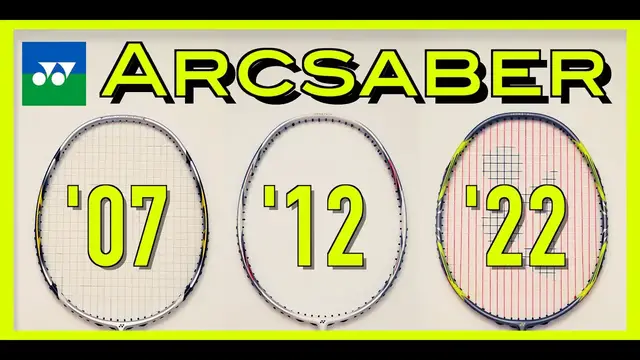
So today, in celebration of your Nexus ARC Fest, I'm going to review and compare all three generations of ARC Saber 7s
0:14
which, some of you might be surprised to learn, first came out in 2007. Let's go
0:20
15 years is a long time in any product's development cycle. Think about it
0:24
The first iPhone was also launched in 2007 and now we now have the iPhone 14 and all of its other variants
0:32
Badminton rackets move a lot slower than the tech industry, but to have the same model and series present for 15 years is something special
0:39
I personally can't remember of any make and model in badminton terms that made it 15 years and is still updated to date
0:47
If you guys do, please let me know down in the comment section below. So when I heard about the new ARC Saber 7 Pro Tour and Play was coming out
0:54
my reviews and comparison years of course. I was keen to compare them to the previous two
0:58
generations of 7s. Being an ARC Saber fan, I did have the original ARC Saber 7 with me
1:04
but had to borrow the second generation ARC Saber 7 to complete this comparison
1:09
Thanks, Dunk. When the first 7 was launched back in 2007, it quickly became very popular
1:15
both amongst the pros as well as us amateurs. My first taste of ARC Saber was actually not the 7
1:20
but the 10. But as many of my friends were playing with the 7 and many of them still do play with the
1:26
7 to date, it certainly stood the test of time. In terms of aesthetics, the original 7 seemed very
1:33
plain compared to the 7 Pro of today. It was silver with bits of black and white trim around
1:38
some of the edges and that was it. One thing that I noticed is there certainly weren't very much
1:43
decals and writings on the frame back then except the carbon nanotubes decal which was significantly
1:49
marketed and promoted on the ARC Sabres. Obviously the rest of the usual stuff is on the shaft
1:54
even balance long shaft etc Marketing was a lot simpler back then wasn it When we moved on to the second generation which I thought was a repaint of the original the second generation 7 was white with a few added red streaks and again didn show
2:08
too much on the frame except the carbon nanotubes. It also had many of the same decals showing
2:13
the characteristics of the updated ARCSABER 7. Both first and second generation ARCSABER
2:19
7s came in 2U and 3U weight classes back then, instead of the 4U of the current ARCSABER
2:25
Saber 7 Pro. Many of you watching will laugh at this but the standard grip sizes back then
2:30
in the UK for these Arc Saber 7s was G3 for the first generation and G4 for the second
2:37
15 years later we finally now have G5 grip sizes in the UK. If you want the in-depth
2:43
breakdown of the 7 Pro, go check out my review here. In terms of measurements, both the first and second generation Arc Saber 7s shared almost
2:51
every single measurement by having the same 21cm shaft length and very similar diameters
2:56
at 7.2 and 7.3mm respectively. Frame thickness was also very similar with the first generation
3:03
having a thickness of 9.9mm and the second bang on at 10mm. Frame heights were exactly
3:09
identical at 23.7cm but width differed slightly at 19cm for the first generation and slightly
3:16
slimmed down to 18.7 for the second generation. Both only had the top half of the frame recessed
3:23
and shared the same handle length of 17.5cm. In comparison, the 7 Pro had a smaller diameter but
3:29
longer shaft, slightly thinner but taller frame, and obviously the now very famous enhanced arc
3:36
saber frames where four sections of the frame are recessed instead of only the top half. In terms of
3:41
I'll be honest, I never got on with first generation ARC Saber 7
3:45
Perhaps I was already so far in love with the feeling that it's coming off the ARC Saber 10s
3:50
that the 7s head lighter and whippier hitting response did not appeal to me
3:55
And many years later it still felt the same Even though the original 7 was a 3U model it still feels fast and is pretty easy to play with It was launched in an era where many rackets was either too soft or too hard very head light or very head heavy It was either or and players
4:11
had to choose and compromise. But with the arc sabers it certainly had a new market where
4:16
there was a lot of playability from the racket alongside responsiveness which catered to
4:20
the needs of a really wide range of players. Like I've always said the arc sabers don't
4:25
stand out at being the fastest or the hardest hitting, but they stand out at being how easy
4:30
they are to play with, and play with well. And this first generation ARC Cyber 7 was
4:35
great at doing that. Also with only a few years into the new point scoring system, many of us were still learning
4:41
about how to maximise and effectively earn points as suddenly, every rally is now worth
4:46
a point. Back in the old system you could relax ever so slightly if you were in the
4:50
red as you knew your opponents couldn't gain a point if it's not their service
4:55
And because the game was transitioning towards having more control of the rallies, it was
5:00
important that Arraket was able to get the players out of trouble as well as having good
5:04
levels of control across both attack and defence, which the ARC Saber 7 was very good at, even
5:11
more so back in 2007. Fast forward a few years and we have the second generation of ARC Saber 7
5:17
Honestly when it was released I didn't even think to try it as I remember me reading online
5:21
that it was only a repaint, however upon testing it now over multiple sessions I felt that
5:26
the second generation was stiffer overall compared to the first generation ARC Saber 7
5:32
The stiffness isn't necessarily only coming from the shaft itself but overall from the
5:36
whole racket, which I liked a lot more compared to the first generation racket
5:40
This made the second generation ARC Saber 7 felt more powerful for me as it had a better
5:45
shaft response, which equates to a better feeling at the same time. Unsurprisingly
5:50
head weight felt very similar to the previous generation, especially when both rackets are
5:54
of similar weight class at 3U It was actually quite a surprise for me to feel that both the first and second generation ARC felt smoother in terms of their swings compared to the current 7 Pro I believe this is down to the slight
6:07
difference in racket weight as well as the frame shape design, where the current 7 Pro
6:12
has more protruding areas around its frame compared to the previous generations. However
6:17
the 7 Pro does swing faster as it's lighter overall thus having a better manoeuvrability
6:24
but it does feel a touch softer in terms of hitting feel. You can always alter the hitting feel with the strings of your choice
6:31
so it doesn't really change too much in this instance. The difference between the 7 Pro and the previous two generations
6:36
is certainly the shuttle hold time. You get more time of the shuttle sitting on your racket strings
6:41
to enable you to make the last-minute shot changes, so that makes easier shot making
6:46
All in all, I can see the progression from all three rackets over the last 15 years that's moving towards establishing
6:52
creation, playability for a wide range of players, enabling us to pull off the shots
6:57
that we'd like to use no matter what level we're at. All with relative ease by not being
7:03
very demanding of course. This went from having a whippier racket head in the first generation
7:07
to a more stable racket in the second generation whilst retaining a lot of the original 7's
7:12
identity to now a speedier version of the racket with more shuttle hold time. Yes, the
7:18
swing feel has changed slightly but then again our game is also evolving all the time
7:23
Obviously the downside to a lighter racket would be the lack of ultimate power, but badminton
7:26
is a complex sport where ultimate power doesn't account for very much if your skill levels
7:30
are close to each other. It's been interesting to look at the development of the playability of the racket in this fashion
7:37
What rackets from the current generations do you think will survive for another 15 years
7:41
and what models do you think they are? Let me know down in the comment section below and I will see you in the next one