Up next in 10



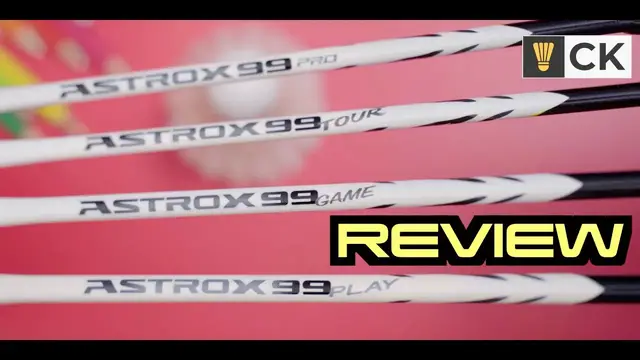
This is a full review and comparison of the Yonex Astrox 99 Tour, Game and Play badminton rackets. The Yonex Astrox 99 Pro sits above these 3 head heavy badminton rackets as part of the Yonex Astrox 99 series. All 4 rackets come in two colours, White Tiger and Cherry Sunburst.
The Astrox 99 Tour, Game and Play rackets are priced at 3 different price points below the Astrox 99 Pro and were released on the 22nd of September 2021 worldwide. The Astrox 99 Tour and Game are made in Taiwan whereas the Astrox 99 Play was made in China.
All rackets tested here are in the 4U weight category and G5 grip size.
Kento Momota and Lee Zii Jia play with the Astrox 99 Pro!
So which is the best Astrox 99 badminton racket for you?
Yonex Astrox 99 Pro review: https://youtu.be/SjG0klxLsVI
Check out my blog post on the Yonex Astrox 99 Pro here: https://www.ckyew.com/post/yonex-astrox-99-pro-review
Chris Adcock Yonex Astrox 99 Pro & Play video: https://youtu.be/Eq1imJHMOjo
Second Gen Astrox 99 Review: https://youtu.be/Ydvg1Mfq-48
Use discount code 'CKYEW' for additional discount.
Yonex Astrox 99 Pro Cherry Sunburst (UK): https://geni.us/99cher
Yonex Astrox 99 Pro White Tiger (UK): https://geni.us/99white
Yonex Astrox 99 (UK): https://geni.us/yc99
Yonex Astrox 99 (Worldwide): https://geni.us/as99
Show More Show Less View Video Transcript
0:00
You've seen the Pro. Now let's go for a tour and play a game
0:09
As I've mentioned before in my Asterox 99 Pro review, Yonex is launching four models of the Asterox 99 at four different price points
0:18
So we start with the Asterox 99 Pro, which is the top of the range, made in Japan, badminton racket, which is currently headlined
0:25
by Kento Momota as well as Lee ZJ of Malaysia at the Sudaman Cup
0:30
It is then followed by three other models, the Asterix 99 Tour and Game, which is made in Taiwan
0:35
and finally the Asterix 99 Play Racket, which is designated as the entry-level Asterix 99 model
0:42
and it's made in China. So if you've not seen my Asterix 99 Pro review, click on here to go and
0:47
check it out and come back for this 99 Tour Game and Play Racket review. So similarly with the 99
0:52
Pro, the Tour Game and Play Rackets also come in two color schemes, both in White Tiger and Cherry
0:58
sunburst, although I am not sure if every single country Yonex is serving will have every single
1:04
model or colour. So for example, you can see the pro and the game version on Yonex Japan's website
1:11
whereas Yonex UK's website will have all four models, but the tour, game and play rackets will
1:16
only come in cherry sunburst. In any case, I'll be showing you all eight rackets here
1:21
four models in two colours each, so stay tuned all the way. Additionally, all the demo sample
1:26
rackets I have here are in 4U G5 spec, so I'm very happy that I'll be able to get a consistent and
1:30
reliable test for comparison here. So thank you to Yonex UK for lending me these rackets for the
1:35
review here, much appreciated. So to set the scene before I go into the nitty gritty bits of each
1:40
racket, I want to talk a bit about the price points that these rackets are representing
1:45
I can see the retail prices from the UK site here, so we'll be using that as a reference
1:49
So each country will be slightly different with taxes and pricing structure, but they should be
1:54
comparable. So in the UK, the Pro will be retailing at £195, the Tour at £150, whereas the Game and
2:02
Play would be at £105 and £60 respectively. So in essence, the Tour is almost 25% cheaper than the
2:09
Pro, the Game is almost half price compared to the Pro, and the Play model is less than a third of
2:16
the price of the Pro. So the key comparison for this would be the different price points and the
2:20
performance amongst the models here and how each of them will work for everyone. So I believe the
2:26
goal from Yonex here is to develop something with a similar design philosophy for a specific series
2:31
and then make it at multiple different price points to suit the customer base. This philosophy
2:37
is well demonstrated across many industries all around the world. Like Apple for example
2:41
the iPhones. You have the top of the line pro model iPhones with the max pro and then the regular
2:47
Pro, and then you have the regular iPhones and the mini iPhones. So again, four different price
2:53
points, I can see a trend going on here. So from what I can see and measure, the Tour and the Pro
2:58
share an identical design, at least on the outside and on the mold. But the difference being, the Tour
3:04
is made in Taiwan with slightly less exotic materials such as having a Rexis shaft and NAMD not being fully used on the entire frame The game on the other hand goes one step down on the design ladder to
3:16
reduce production complexity, hence a reduction in production cost, as well as even using even less
3:22
exotic materials, for example with NanoMesh Neo. The player model then followed what the tour did
3:28
with the Pro and have the same design as the game, but this time is made in China and again
3:35
using slightly more affordable materials. So how did I come up with these two design explanations
3:40
It's from the spreadsheet that I've made from all the measurements I do on each racket that I've
3:44
tested on this channel. You can see the Pro and the Tour racket shares almost every single measurement
3:50
on them with very minor differences, with a longer shaft and a slightly shorter wooden handle on the
3:55
Tour compared to the Pro. But the frame height, width and thickness were identical, so even the
4:01
shaft diameter were almost identical from the Pro and the Tour. So pretty amazing production quality
4:06
for a supposedly mid-high-end racket. We then look at the game and play racket's measurements
4:12
and for a second you can again see this trend of both rackets sharing almost every single
4:17
measurements except they were made in different countries. They do however defer from the Pro and
4:22
Tour model by having a bigger frame, but with only a half recess frame profile instead of a full one
4:28
found on the Pro and Tour. Surprisingly, they do have an ever so slightly thinner frame compared to
4:33
the two more expensive models here. So visually, besides the Tour, Game and Play decals on the
4:38
rackets, the only other difference are the control support caps. The Tour has the same cap as the
4:44
Pro, whilst the Game had the previous generation's Asterix 99 support cap, and the Play ended up with
4:49
a super basic, no design support cap. Another difference would be the holographic sticker
4:53
as well as the rackets' weight and grip size sticker. The Taiwan-made Tour and Game rackets
4:58
had an oval Yonex holographic sticker and laser etched racket weight and grip size
5:03
while the China-made Play had stickers on both. Long story short, I'm very impressed with the production quality of all these rackets
5:10
and it's not my first time seeing Yonex's made-in-Taiwan rackets, but from my experience of seeing previous tour and game models from the 100, 88S and 88D series
5:20
Yonex has set a really high standard for production and performance of these rackets here
5:26
One surprise from the bunch was certainly the Made in China's Play model. Now, I'll be honest and say I don't necessarily come across plenty of Yonex's Made in China rackets
5:35
as Yonex traditionally priced the rackets based on the country of production
5:40
Japan for the top-tier rackets, Taiwan for the mid-to-low range, and China for the really low-end entry-level rackets
5:47
And what I mean by low-end entry-level rackets are the recreational models that come, for example
5:52
four in a pack for use in a back garden barbecue or at the beach at a super affordable price
5:58
They generally are steel frame rackets, which will take a lot of abuse, but won't do very well if you're thinking about performance and feel
6:06
And from experience of stringing some of these rackets, these frames don't do very well at tensions above 20 pounds
6:14
So when I see the Play model being a made model there the thought of the previous experiences of Yonex made models and I have a slight reservation of oh my god is this going to be okay So as the rackets came
6:27
factory strung with pretty rubbish strings and really low tensions, I decided to restring the
6:33
Cherry Sunburst models completely with my usual playing string and tensions. So AeroBite at 26
6:39
by 28 pounds in tension. So every single racket in the Astrox 99 range is rated up to 28 pounds
6:45
and tension for the 4U models and would be £29 for the 3U models. They all have the same stringing
6:52
pattern as well as having the four rows of bigger grommets in the 3 and 9 o'clock region of the
6:57
racket. So from my experience of stringing them, they also share the wider gaps in the mains around
7:02
the central area of the rackets too. So stringing wise, the Pro is extremely solid and very good
7:09
frame to string. The Tour and Game also had no issues with stringing as well. But when it came
7:14
to string in the play racket, I again had that, oh my god, is this going to be okay? Will it survive
7:21
Ultimately, I decided to go with it and stick to my planned string intention of 26 by 28 pounds
7:27
as this is a real world review, right? If it didn't hold up when it was rated for it
7:31
then we need to know. So when I was stringing the play racket, I could certainly see the frame
7:35
flexing the most out of the four, but this is certainly to be expected, as certainly less
7:40
exotic materials were used to make this racket, but ultimately it came out perfectly fine. So I
7:46
was very relieved but impressed at the same time, as in the thousands of rackets that I've done
7:50
I've never done a made-in-China Yonex racket at 26 by 28 pounds in tension. So remember to hit the
7:56
subscribe and like button whilst you're here and leave your thoughts down in the comments section
8:00
below too. So when it came to testing, I started out with my usual 88D Pro just to refresh my
8:06
baseline feel before heading to the 99 Pro and going down to the tour then game and ending with
8:12
the play for each test section. And you all know my summary for the 99 Pro was a big sweet spot
8:19
pretty fast, super head heavy sledgehammer, physically demanding to use and fast flat shots
8:24
will certainly be tiring very quickly if you're not crazy strong. However there was plenty of power
8:29
and stability on tap for the racket especially at the rear court but also pretty much everywhere
8:34
else too. So when I moved from the Pro to the Tour, the difference was significant. The Tour
8:40
was significantly lighter in the head. So George, who was my training partner here in this video
8:45
also tried the Pro than the Tour and both came out with the same conclusion. The Tour is also
8:51
faster compared to the Pro, especially around the mid-court area, and that will come from the
8:56
headweight difference. However, it certainly did not feel as smooth as the Pro, but only ever so
9:02
slightly. The difference in head weight was so apparent that for a moment I thought the tour
9:06
racket did not have a power assist bumper, but it did. So imagine the racket without it. So another
9:12
thing that stood out for me was the difference in feeling compared to the pro model. So the tour
9:16
racket feels more hollow compared to the pro model and this has been a consistent thing for the made
9:21
in Taiwan models. So I guess this might be from a specific material or even a production technique
9:26
which is different to Japanese made models I believe the Japanese made rackets have something called a solid core hitting feel which perhaps is different from the Taiwanese made rackets So moving on to the game So the game is a touch lighter than the
9:41
Tour and doesn't even feel head heavy at all compared to the Pro at this point
9:44
But even with the head lightness it isn't any faster than the Tour model
9:49
Also note I said in my 99 Pro review that the Pro has a new head shape for a
9:54
bigger sweet spot. So the Tour has the same Pro head shape but not the game and the play. So this
10:01
coupled with the traditional head shape for an Astrox with a half recess frame profile is the
10:06
reason why the game isn't any faster than the Tour. It also shares the slightly hollow feeling that the
10:13
Tour has but still plays amazingly well. So everything is fast in the mid-court area but
10:18
certainly lack top-end power in the rear court. Stability at the same time isn't as solid as the
10:23
pro but not too bad nonetheless. So it's a very happy racket to play with. So we now come to the
10:29
bottom of the bunch, the play. And as soon as I started to play with it, I immediately told George
10:34
that this one is my favourite out of the three. I was already impressed it held fine from the
10:39
stringing and after a few hits the more familiar solid feeling that comes with the Japanese rackets
10:44
are now back. It's not 100% the same but certainly close. Yes the play was a touch slower than the
10:51
Tour and Game, but I thought it actually felt like it had more weight in the head than the other two
10:56
The play also felt a touch stiffer compared to the Tour and Game models at the same time. So don't
11:02
get me wrong, the Tour and Game rackets were very nice rackets to play with, but this play, I just
11:07
cannot believe how nice it is to play with. It is super smooth and amazingly well built for an entry
11:12
level racket that is less than a third from the Pro's price. The performance is certainly not one
11:17
third of the pro model I can tell that much the performance difference from the play with the three
11:23
other models were almost minimal compared to how wide the pricing gaps are I just kept going back
11:29
and forth from the play to the other rackets and I just cannot believe how well built it was for its
11:34
price it certainly made a big impression with me I can't wait to do a test like this with someone
11:39
like Chris Sackle again when the rackets are all strung properly and I'd like to hear what he has
11:43
say about the value of these rackets compared to how they played. One teeny tiny imperfection from
11:49
the play was the racket weight and grip size sticker on the Cherry Sun Bruce wasn't stuck
11:55
on properly, but this wasn't present on the White Tiger model, so this is just a one-off and something
12:00
that is aesthetic and doesn't affect racket performance. All in all, if you want an easier
12:04
to play version of the 99 Pro, get the game. If you have a bit more budget and wants everything
12:10
just a few percent better, get the tour. If you want an amazing value racket that can take decent
12:16
tension and plays amazingly well for the prize, go for the play. I'm sure lots of players are going
12:21
to be very impressed with this model and I still cannot believe how good the play is considering
12:26
the value. So just remember always to restring these rackets to a usual string and tension and
12:31
you'll be impressed at how well they play. Until then, remember to subscribe and I will see you in
12:36
in the next one
#Table Games
#Sports
#Individual Sports
#Racquet Sports
#Sporting Goods
#Table Tennis
#Squash & Racquetball Equipment
#Table Tennis Equipment
#Tennis Equipment